Authority
Where internal PageRank collects, which pages feed it and where it is lost.
Internal PageRank
Authority ranks the site's pages by internal PageRank: how much link value reaches each page through the site's own links. Every page passes value on, split evenly over the different pages it links to, and a page linked from strong pages becomes strong itself. The size of a page on the graph follows this ranking.
Scores are shown relative to the strongest page, which is 100. A page at 50 receives half as much internal link value as the strongest one.
Content links or all links
- Content links only
- Counts only links placed in page content: the authority your editorial linking distributes. The default, because it is the part you control page by page.
- All internal links
- Counts every internal link, navigation and footer included: what search engines see. The sitewide menu dominates here, which is why utility pages such as contact or imprint often rank high.
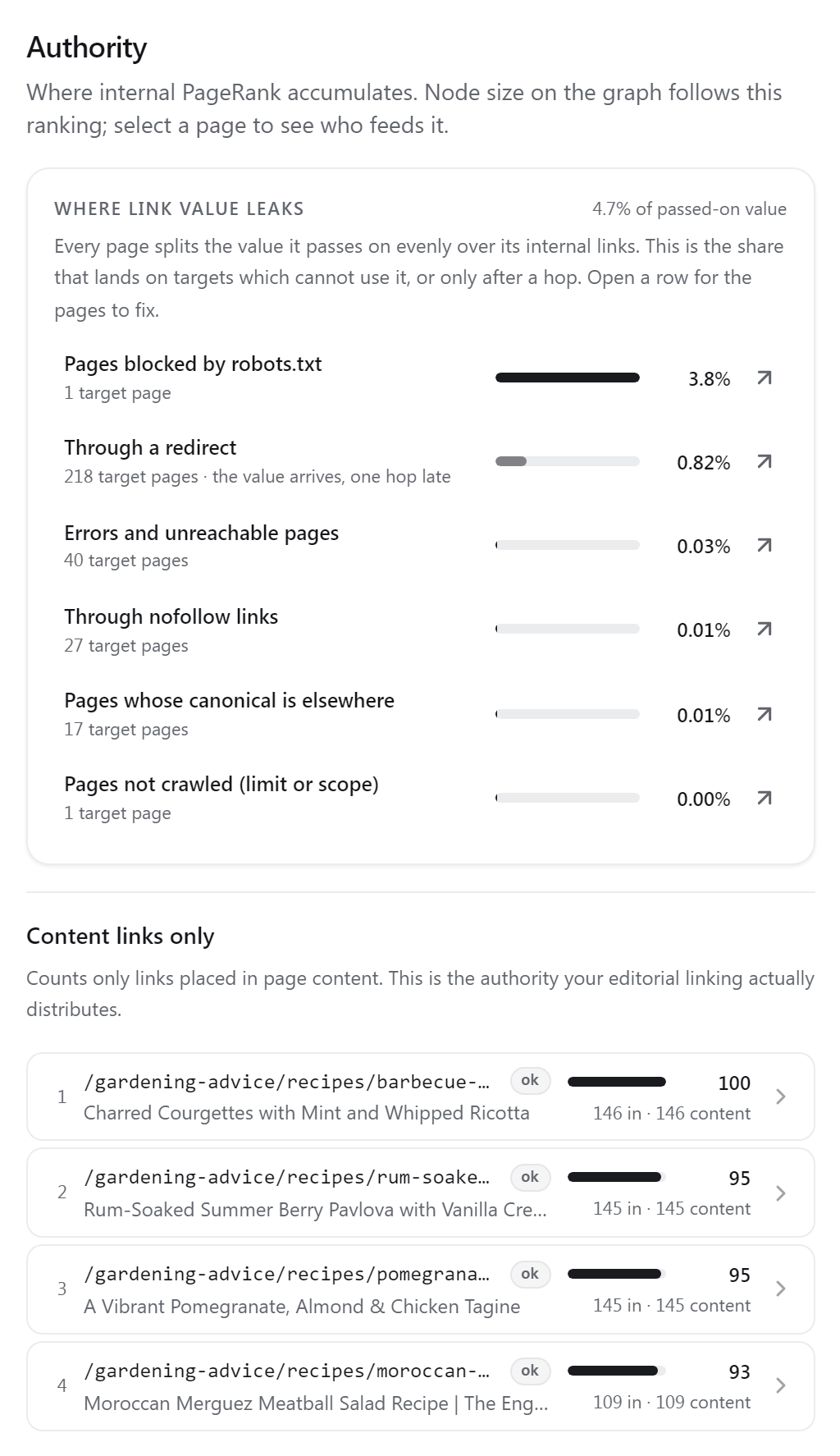
Where link value leaks
Above the ranking, when anything leaks, a block shows which share of the value pages pass on lands where it cannot be used, or only after a detour:
- Through nofollow links: the link takes its share and passes none.
- Errors and unreachable pages: the value lands on a broken URL.
- Through a redirect: the value arrives, one hop late.
- Noindex pages and pages whose canonical is elsewhere: the value lands on a page that will not rank.
- Pages blocked by robots.txt.
- Pages not crawled: outside the scope, or beyond the page limit.
Each row opens the matching check in Issues with the pages to fix, or, for pages not crawled, the Pages list of those URLs.
Who feeds a page
Select a page to focus it and its neighbours on the graph. Its details open on the inbound links, strongest first: each link shows the share of all the link value this page receives that it brings. On outbound links the share is what the page passes through that link. A link marked none passes nothing: it is nofollow, or its target is broken or was not crawled.